
Nobody reads the fine print on a can of Coke. Most people crack it open, take a sip, and move on with their day. But if you sell food or beverages for a living, that can of soda carries a tax story inside it that most business owners have never been told.
Not too long ago, I wrote about something that genuinely surprised me at the Walmart checkout line. A 2-liter bottle of Coke costs more per gallon than the gasoline I pumped into my wife’s car. The math was uncomfortable, and the reaction from readers told me one thing clearly: people are hungry for the kind of honest, numbers-first conversation that most financial content refuses to have.
So let us keep going. Because buried inside that same bottle of Coke is a tax mechanism that most business owners in food and beverage have either never heard of, or do not fully understand. And if you sell sugary drinks, manufacture beverages, distribute them, or run any kind of food service operation, understanding this could change how you price, plan, and protect your margins.
This is the world of excise taxes. And once you see how they work, you will never look at a drink menu the same way again.
What Is an Excise Tax and Why Should You Care
Most people understand sales tax. You buy something, a percentage gets added at the register, and the government collects it from the customer. Simple enough.
An excise tax works differently. Instead of hitting the consumer at the point of sale, it typically hits further up the chain, at the level of the manufacturer, distributor, or importer. The tax gets baked into the cost of the product before it ever reaches a shelf. By the time a customer picks it up, the tax is already inside the price. They pay it without seeing it.
The federal government has used excise taxes for a long time on things like gasoline, tobacco, and alcohol. State and local governments have used them too. And in recent years, a growing number of cities have applied this same mechanism specifically to sugar-sweetened beverages.
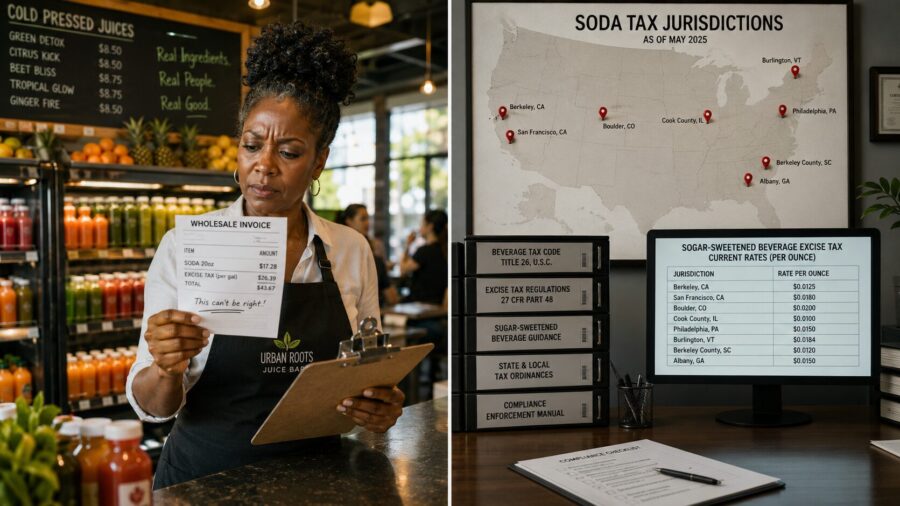
As of right now, soda taxes exist in several U.S. jurisdictions including Philadelphia, Seattle, Boulder, the District of Columbia, and four California cities: Berkeley, Albany, Oakland, and San Francisco. Most of these taxes are structured as a per-ounce levy, typically ranging from one to two cents per fluid ounce. That sounds small. However, when you run the numbers across volume, it adds up fast.
A one-cent-per-ounce tax on a 2-liter bottle works out to roughly 68 cents per bottle. Across a pallet of product, that becomes real money. Across a distribution network, it becomes a very serious cost line.
The Pass-Through Problem Nobody Warns You About
Here is where it gets interesting for business owners, and honestly a little unfair.
Excise taxes on beverages are almost always levied on the distributor, not the retailer or the end consumer. The distributor pays the tax when the product enters the taxing jurisdiction. In theory, that cost then gets passed down the chain through higher wholesale prices. The retailer absorbs some of it. The consumer absorbs the rest. This process is what economists call tax pass-through.
But pass-through is never perfectly clean. Research on soda taxes in Philadelphia and Boulder found that retailers pass on roughly 70 to 100 percent of the excise tax to consumers through higher shelf prices. However, not all retailers can do that equally. A large grocery chain with strong supplier leverage and thin margins can adjust pricing quickly. A small neighborhood convenience store, a local juice bar, or an independent restaurant often cannot.
If you run a food and beverage business in a soda-tax jurisdiction, you are absorbing a cost that was never formally assigned to you. It arrived through your supplier’s pricing, and it is sitting quietly inside your cost of goods sold. Whether you have noticed it or not.
This is the same invisible cost principle I talked about in the gas versus Coke article. The cost you cannot see is the one most likely to eat your margins without warning.
What This Means if You Sell Food or Beverages
Let me make this concrete. Suppose you run a small restaurant in Philadelphia. You buy cases of sweetened beverages from a local distributor. That distributor has already paid the city’s 1.5-cent-per-ounce excise tax on every bottle. They have passed most of that cost to you through their wholesale price. You have passed some of it to your customers through your menu. But the portion you absorbed quietly became part of your overhead.
Now multiply that across every sugary drink, energy drink, sweetened tea, and sports drink you carry. In a busy restaurant doing meaningful volume, that invisible excise cost could add hundreds or even thousands of dollars annually to your actual cost of operations. And most owners have never isolated it as a line item.
Beyond the direct cost, there is also a compliance dimension. If you are a distributor, importer, or manufacturer operating in or across a soda-tax jurisdiction, you may have direct filing and remittance obligations. Failing to understand those obligations can result in penalties that dwarf the original tax itself. The IRS and local tax authorities are not sympathetic to the answer:
“I did not know.”
If your business operates across multiple states or cities, the picture gets more complex still. Each jurisdiction has different definitions of what qualifies as a taxable sugary beverage, different rate structures, different exemptions, and different filing timelines. Some tax diet sodas while others do not. Certain people also tax fruit drinks. Others exempt them. Running a regional distribution operation without a clear map of your excise exposure is genuinely risky.
The Deductibility Question You Need to Ask
Here is a piece of the puzzle that most food and beverage owners miss entirely.
Excise taxes paid in the course of your business operations are generally deductible as ordinary and necessary business expenses under IRC Section 162. If you are a distributor paying a per-ounce soda tax as part of your cost of doing business, that tax payment is not just a cost. It is a deductible cost. That distinction matters for your bottom line.
However, and this is important, you have to be tracking it. If your excise tax payments are buried inside your cost of goods sold and never broken out, you may be deducting them implicitly. But you may also be missing opportunities to document, substantiate, and optimize around them. Proper categorization matters, especially if the IRS ever questions the nature of your cost of goods or your gross margin calculations.
This is the kind of conversation worth having with your tax advisor before you file, not after. And if your advisor has not brought it up, that might be a signal worth paying attention to. You can read more about how proactive tax planning works in my article on why your CPA cannot save you in January.
The taxes hiding inside your cost of goods are just as real as the ones on your return. The difference is who is paying attention.
The Bigger Lesson for Every Business Owner
Even if you are not in food and beverage, the soda tax story carries a principle worth internalizing.
Excise taxes are one example of a category I think of as embedded costs: charges, levies, and regulatory expenses that get absorbed into pricing structures before they ever reach you, but that still affect your margins, your suppliers, your customers, and ultimately your tax position. Fuel excise taxes do the same thing to every business that ships product or operates vehicles. Alcohol excise taxes shape the economics of every bar, restaurant, and hospitality business. Tobacco excise taxes restructure the entire economics of convenience retail.
In each case, the business owner who understands where the tax sits in the chain, what it costs at each layer, whether it is deductible, and how to plan around it, ends up in a meaningfully better position than the one who simply accepts the price their supplier quotes and moves on.
This connects directly to something I explore in the Tax Strategy and Entity Structure piece: the businesses that win on taxes are not the ones with the best luck. They are the ones that treat the tax code as a system to understand rather than a bill to pay.
Because once you understand the system, the invisible costs start to become visible. And visible costs can be managed.
A Few Things Worth Doing Right Now
If you operate in food and beverage, or if you source from suppliers in soda-tax jurisdictions, a few practical steps can make a real difference.
First, ask your distributor or supplier to break out any excise tax components in their pricing. Most will not volunteer this. However, you are entitled to understand what you are paying for.
Second, work with your bookkeeper or accountant to ensure those costs are categorized correctly in your chart of accounts. Proper classification protects your deductions and gives you a clean picture of your true cost of goods.
Third, if you operate across multiple jurisdictions, map your excise exposure by location before it maps you.
Finally, if you have never had a conversation with your tax advisor specifically about embedded taxes in your supply chain, that conversation is overdue. Not because something is wrong, but because something might be improvable.
The soda on your shelf has a tax story inside it. The question is whether you are the one telling it, or the one it is being told to.
Because in the tax world, there is always someone paying attention to the costs you are not.
Welcome to the New Age of Accounting. Let’s begin.
P.S. If you found this article helpful, you’ll love my new book S-Corp Mastery: How Smart Business Owners Maximize Tax Savings & Build a Lasting Legacy. It’s now live and available in a sleek, easy-to-read PDF version. Grab your copy here

Chris is the Managing Partner at Weston Tax Associates, a best-selling author, and a renowned tax strategist. With over 20 years of expertise in tax and corporate finance, he simplifies complex tax concepts into actionable strategies that drive business growth. Originally from Sweden, he now lives in Florida with his wife and two sons.