

Quarterly tax payments are required for individuals and businesses who expect to owe $1,000 or more in taxes ($500 for corporations) at year-end and don’t have sufficient tax withheld from income. These payments cover income tax, self-employment tax, and more, and are typically made by those with income from self-employment, investments, rental properties, or other non-wage sources.
Key Points to Know:
- When Payments Are Due: April 15, June 15, September 15, and January 15 (next year).
- Who Needs to Pay: Those with untaxed income or inadequate withholdings, like freelancers, investors, and landlords.
- How to Calculate: Use IRS Form 1040-ES and ensure payments meet safe harbor rules (90% of current-year tax or 100%-110% of prior-year tax, depending on income).
- How to Pay: Options include IRS Direct Pay, EFTPS, credit/debit cards, and checks.
Avoid Penalties: Missing deadlines results in penalties (0.5% of the unpaid amount per month). Stay on track by calculating accurately, meeting deadlines, and keeping detailed records.
This article explains how to determine if you need to pay, calculate amounts, and avoid penalties.
How to Calculate Quarterly Estimated Tax Payments | Do You Need to Pay Quarterly Taxes?
Figuring out if you need to make quarterly tax payments is a key part of managing your taxes. The IRS has specific rules to determine if you’re required to pay estimated taxes during the year.
When Are Quarterly Taxes Required?
You need to pay quarterly taxes if you expect to owe $1,000 or more in taxes as an individual ($500 for corporations) after subtracting withholdings and credits. This applies when your withholdings and refundable credits are less than either:
- 90% of your current year’s total tax bill, or
- 100% of last year’s total tax bill (assuming it covered a full 12-month period).
Income sources that often require quarterly payments include earnings from self-employment, investments, rental properties, prize winnings, and sharing economy platforms. However, there are exceptions to these rules.
Exceptions to Quarterly Tax Payments
You don’t need to make estimated tax payments if you meet all three of these conditions:
- You had no tax liability in the previous year.
- You were a U.S. citizen or resident alien for the entire year.
- Your previous tax year was a full 12-month period.
There are also special rules for certain groups:
- Farmers and fishermen: They follow different rules due to seasonal income patterns.
- Retired or disabled individuals: If you retired (after age 62) or became disabled during the year, penalties may be waived.
- Disaster victims: Penalties might be waived if underpayment was caused by a disaster, casualty, or unusual circumstances.
Even if your employer withholds taxes from your paycheck, you may still need to make quarterly payments if you earn significant extra income from other sources.
Calculating Your Quarterly Payments
Accurately calculating your quarterly tax payments is key to avoiding penalties and ensuring you don’t overpay.
Step-by-Step Guide to Form 1040-ES
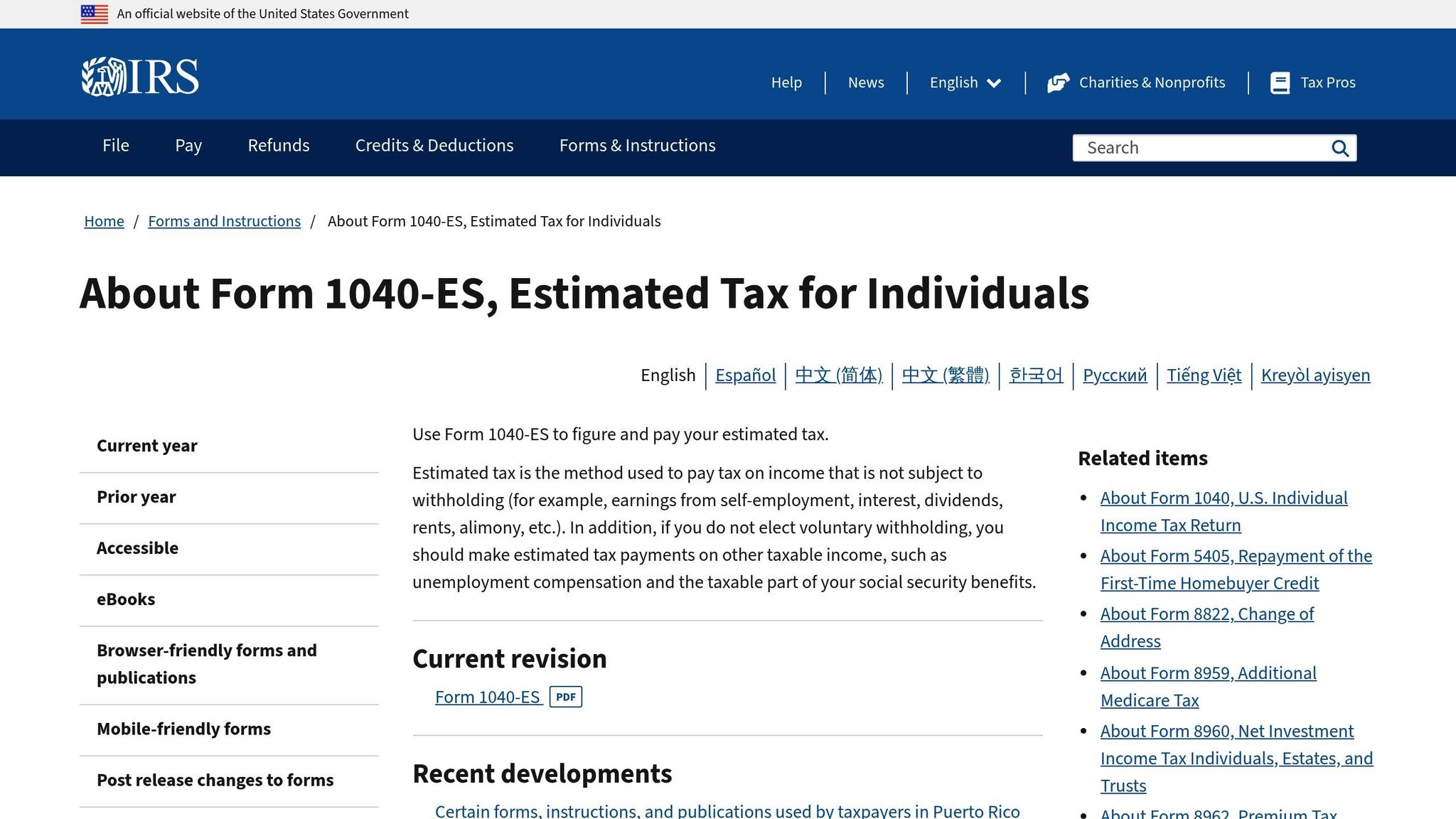
Gather all income details, including self-employment earnings, investment income (interest and dividends), rental income, capital gains, prize money, awards, alimony, and any other untaxed income. Then, use Form 1040-ES to calculate your estimated tax by following these steps:
- Estimate Annual Income
Calculate your adjusted gross income (AGI) by adding up this year’s income and subtracting deductions. If you’re unsure, last year’s return can serve as a helpful starting point. - Apply Current Tax Rates
Use the current IRS tax brackets to determine your total tax liability. Be sure to include income tax, self-employment tax, and any alternative minimum tax that applies. - Account for Credits and Withholdings
Subtract any tax credits you expect to claim, along with tax withholdings from W-2 employment or other tax payments you’ve already made.
Once you’ve calculated your estimated tax, make sure your payments align with IRS safe harbor rules to avoid penalties.
Meeting Safe Harbor Requirements
The IRS safe harbor rules are designed to help taxpayers avoid penalties for underpayment.
Standard Safe Harbor Rules:
- Pay at least 90% of your current year’s tax liability, or
- Pay 100% of your previous year’s tax liability (if it covered a full 12 months)
Special Rules for Higher Income Taxpayers:
If your adjusted gross income (AGI) is over $150,000 (or $75,000 if married filing separately), the requirements change slightly:
- Pay 90% of your current year’s tax liability, or
- Pay 110% of your previous year’s tax liability
| Income Level | Safe Harbor Payment Options |
|---|---|
| Regular Income | 90% of current year or 100% of prior year |
| AGI > $150,000 | 90% of current year or 110% of prior year |
For those with fluctuating incomes, consider annualizing your income to adjust your quarterly payments accordingly.
Tax Strategist Pro Tip: If you also have W-2 income, increasing your withholding can help cover your estimated tax obligations. This approach may offer more flexibility than making quarterly payments.
When and How to Pay
Due Dates for Each Quarter
Quarterly tax payments are scheduled as follows:
| Quarter | Period Covered | Due Date |
|---|---|---|
| Q1 | January 1 – March 31 | April 15 |
| Q2 | April 1 – June 30 | June 15 |
| Q3 | July 1 – September 30 | September 15 |
| Q4 | October 1 – December 31 | January 15 (next year) |
If the due date lands on a weekend or a legal holiday, it automatically moves to the next business day. For fiscal-year taxpayers, payments are due on the 15th day of the 4th, 6th, and 9th months of the fiscal year, plus the 15th day after the tax year ends.
Now, let’s look at how you can make these payments.
Ways to Submit Payments
Once you know your deadlines, choosing the right payment method is just as important. Here’s a breakdown of your options:
Digital Methods:
- IRS Direct Pay: Free and direct from your bank account.
- EFTPS: Lets businesses schedule payments and view their payment history.
- IRS2Go Mobile App: Convenient payment through your smartphone.
Traditional Methods:
- Credit or Debit Cards: Note that processing fees apply.
- Digital Wallet: Pay using apps like PayPal or Venmo.
- Cash: Available at select retail locations.
- Check or Money Order: Use Form 1040-ES as a payment voucher.
Helpful Tips:
- Visit IRS.gov/payments for a full list of payment options.
- Always save confirmation numbers for electronic payments.
- Businesses might be required to use EFTPS for their quarterly payments.
sbb-itb-99cfa38
Missing Payment Consequences
Understanding Tax Penalties
If you miss quarterly tax payments, the IRS charges penalties and interest. The standard penalty rate is 0.5% of the unpaid amount per month (or part of a month), capped at 25%. For instance, if you owe $10,000, you’d face about $50 in penalties each month until the balance is addressed.
Here’s how the penalty rates can vary depending on your situation:
| Situation | Monthly Penalty Rate |
|---|---|
| Standard Late Payment | 0.5% |
| IRS Property Seizure Intent | 1.0% |
| Active IRS Payment Plan | 0.25% |
Interest and penalties can add up quickly, making it essential to address unpaid taxes promptly.
Preventing Tax Penalties
You can reduce or avoid penalties and interest by taking these steps:
- Make partial payments: Even paying part of what you owe reduces the interest that accrues.
- Set up an IRS payment plan: If your debt is under $50,000, you can request a payment plan. This lowers your penalty rate to 0.25% per month, cutting penalty costs in half.
- Follow safe harbor rules: Meeting these guidelines ensures you won’t face penalties.
- Keep detailed records: Document all payments and IRS communications. If you have a valid reason for missing payments, you may qualify for a penalty waiver by showing reasonable cause.
For more complicated situations or larger tax liabilities, consider using Form 2210 ("Underpayment of Estimated Tax by Individuals, Estates, and Trusts") to calculate potential penalties. Alternatively, you can leave the quarterly tax payments section blank on your return, and the IRS will calculate the penalty for you.
Resources and Professional Help
Tools Offered by the IRS
Managing your taxes efficiently doesn’t stop at choosing how to pay. The IRS provides several tools to make quarterly tax payments easier, including:
- Direct Pay: A secure system linking directly to your bank account.
- Electronic Federal Tax Payment System (EFTPS): A free service that lets you schedule payments up to a year in advance.
- Form 1040-ES Calculator: Helps estimate your quarterly payments based on income and deductions.
The IRS website also offers downloadable tax calendars and reminders to help you stay organized. If you need more personalized guidance, consulting a tax professional may be a smart move.
Benefits of Working with Tax Professionals
Tax professionals can make managing quarterly taxes simpler, whether for personal or business needs. Their expertise can help you navigate the process more efficiently.
"When our bookkeeper retired, we decided to look for new representation. It was one of the best business decisions we’ve ever made. Thanks for everything!" – Ricardo M., Marketing Agency Owner
Keeping Track of Tax Payment Records
Organizing your tax payment records is crucial for a hassle-free process. Here are the key documents you should keep track of:
| Document Type | Retention Period | Purpose |
|---|---|---|
| Payment Confirmations | 3 years | Proof of payment |
| Bank Statements | 3 years | Payment verification |
| Income Records | 3 years | Support for payment calculations |
| Form 1040-ES Copies | 3 years | Documentation of payment amounts |
It’s a good idea to store these records in both digital and physical formats. Secure cloud storage with backup options can help you keep everything organized, including confirmation numbers, payment dates, and amounts.
Real-Life Examples and Common Mistakes
Now that we’ve covered calculation methods and payment requirements, let’s look at some real-world examples and common mistakes. These examples highlight how careful planning with quarterly tax payments can help you avoid penalties.
Payment Calculation Examples
Freelancers, small business owners, and those with mixed income need to take extra factors into account. Things like self-employment tax, business deductions, and varying withholdings all play a role in accurate calculations. These examples provide context for understanding how errors can disrupt your payment process.
Avoiding Common Errors
Here are some frequent mistakes people make – and tips to avoid them:
- Underestimating Income Changes: If your income goes up, like when you start a new business, update your quarterly payments using Form 1040-ES to avoid falling behind.
- Uneven Income Adjustments: For jobs with seasonal or commission-based income, annualizing your earnings can help you avoid underpayment penalties. The IRS may waive penalties if the underpayment is due to unusual circumstances, not neglect.
- Missing Payment Deadlines: If you miss a deadline, pay as soon as possible to reduce extra charges.
- Incorrect Payment Calculations: Skipping self-employment tax, overlooking income sources, or misusing credits and deductions are common missteps. To stay on track, consider consulting an accountant for accurate estimates and performing regular "paycheck checkups" to ensure your payments match your tax obligations.
Key Points to Remember
Here’s a quick rundown of important details about quarterly tax payments:
Meeting deadlines is crucial for managing quarterly taxes effectively. The IRS sets specific due dates: April 15, June 15, September 15, and January 15 of the following year. If a due date falls on a weekend or federal holiday, the payment is due the next business day.
You’re required to make quarterly tax payments if you expect to owe $1,000 or more in taxes after accounting for withholdings and refundable credits. To avoid penalties, ensure your withholdings and estimated payments cover at least 90% of this year’s tax liability or 100% of last year’s tax liability.
Tax penalties are increasingly common, with cases rising from 7.2 million in 2010 to 10 million in 2017. To help you avoid penalties, the IRS offers these tools:
| Resource | Purpose |
|---|---|
| Form 1040-ES | Use this to calculate and pay estimated taxes |
| IRS Tax Withholding Estimator | Helps you figure out the correct withholding amounts |
| Publication 505 | Provides detailed instructions on tax withholding |
Keep all payment confirmations and quarterly records. Adjust your estimates if your income or deductions change, and don’t forget to check your state’s specific tax requirements – they may differ from federal rules.
These steps can help you stay on track and avoid unnecessary penalties. As always, feel free to reach out to us if you have any questions or need any type of tax advice.
Welcome to The New Age of Accounting. Let’s begin.

Chris is the Managing Partner at Weston Tax Associates, a best-selling author, and a renowned tax strategist. With over 20 years of expertise in tax and corporate finance, he simplifies complex tax concepts into actionable strategies that drive business growth. Originally from Sweden, he now lives in Florida with his wife and two sons.