
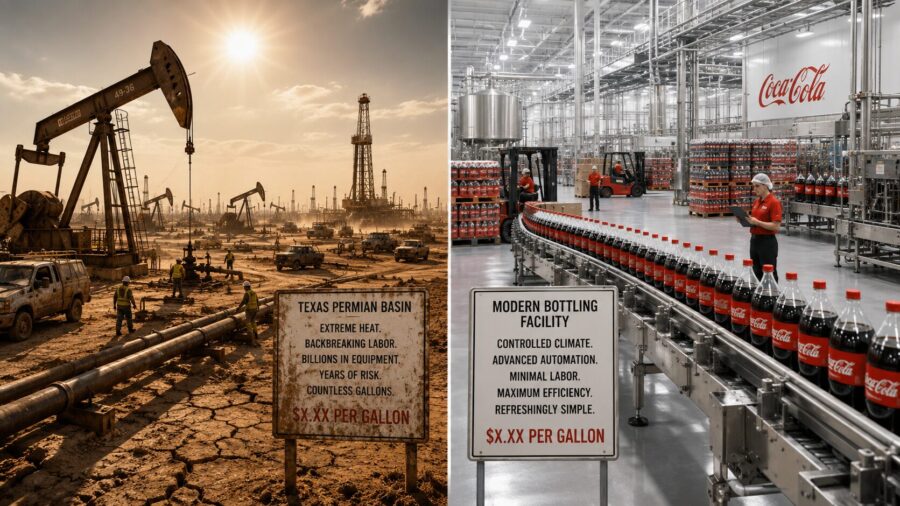
There are two things Americans love to do at a gas station. The first is complain about the price on the pump. The second is walk inside and buy a Coke without giving it a second thought.
I did exactly that not long ago. I pulled up to fill my wife’s car, watched the total climb past forty dollars, and muttered something under my breath that I will not repeat here. Then I went inside, grabbed a 2-liter bottle of Coke for the party we were throwing, paid my $2.97, and drove home feeling like I had somehow been cheated by one of those purchases.
Here is the thing. I had the wrong one picked out.
Because when you actually sit down and compare what goes into making a gallon of gasoline versus what goes into making a 2-liter bottle of Coca-Cola, the numbers tell a story that most people have never stopped to hear. And as someone who spends his professional life looking at numbers that other people miss, this one stuck with me.
Let’s Start With the Math Nobody Does
A standard 2-liter bottle of Coca-Cola contains roughly 67.6 fluid ounces. At $2.97 from Walmart, that works out to about $1.49 per liter. A gallon of gas is approximately 3.785 liters. So to buy the same volume of Coca-Cola as one gallon of fuel, you would spend right around $5.64.
Meanwhile, as of this week, the national average for a gallon of regular gasoline sits at approximately $4.50, according to the U.S. Energy Information Administration.
So liter for liter, Coca-Cola still costs you more than gasoline. At $5.64 per gallon equivalent versus $4.50 at the pump, Coke runs about 25 percent higher than gas. Next time you walk past the pump and into the convenience store to grab a soda, just remember that you are buying the more expensive liquid. You are just doing it in smaller quantities so it feels cheaper. That is the trick.
What Actually Goes Into a Gallon of Gas
To really understand why this matters, you have to think about what you are actually paying for.
Gasoline starts as crude oil that sits thousands of feet underground. Getting to it requires heavy drilling equipment, offshore platforms, pipelines, tankers, and years of geological surveying. Once extracted, crude oil is transported to a refinery, where it gets broken down through a process called fractional distillation. From there, it gets blended, treated for emissions compliance, transported again through pipelines or trucks, stored at distribution terminals, and finally delivered to the gas station where you pull in and complain about the price.
As I glance at the crude oil chart right now, WTI is trading somewhere around $103 to $107 per barrel, with Brent sitting above $110. That is driven largely by the disruption to the Strait of Hormuz and the ongoing tension with Iran, which has effectively shut down a chokepoint responsible for roughly 20 percent of global oil flows. The supply chain for a gallon of gasoline involves geopolitical risk, multi-billion-dollar infrastructure, environmental compliance costs, federal and state taxes, refinery margins, and the kind of logistics complexity that would give most operations managers a migraine.
And yet, somehow, you are still paying less per liter for that gallon than you are for your Coke. Think about that for a second.
What Actually Goes Into a Bottle of Coke
Now let us look at the other side of this comparison.
The ingredient list for a 2-liter Coca-Cola reads as follows: carbonated water, high fructose corn syrup, caramel color, phosphoric acid, natural flavors, and caffeine. That is it. There is no drilling. There is no refinery. There is no geopolitical tension in the phosphoric acid supply chain, at least not one that makes the evening news.
Corn syrup is one of the most abundant and heavily subsidized agricultural products in the United States. Carbonated water is, well, water and CO2. The flavoring formula, while famously secret, is not being extracted from ten thousand feet underground. Coca-Cola mixes these ingredients, puts them in a plastic bottle, ships them to a Walmart near you, and charges you $2.97.
That is a masterclass in perceived value. And it connects to something I have written about before, specifically the idea that how we perceive a cost shapes how we respond to it. You can read more about that in Why Smart Business Owners Treat Taxes as a Strategy, Not a Bill, which explores how changing the frame around a cost changes what you do about it.
The Real Lesson Is About Perception, Not Pricing
Here is where this stops being a fun economics exercise and starts being something useful.
Americans have been conditioned to treat gas prices as the universal barometer of economic pain. Politicians talk about them. News anchors track them daily. People post photos of pump receipts like they are evidence of a crime. But they walk into the same station, grab a 20-ounce bottle of Coke for $2.48, and never think twice. That 20-ounce bottle, by the way, works out to about $15.88 per gallon equivalent. Higher than gas, higher than the 2-liter, and consumed in about four minutes.
The outrage is not really about the price. It is about visibility. The gas price is enormous, right there on the sign, unavoidable. The soda price is small and friendly-looking on a shelf inside. Same math, completely different emotional response.
This is actually one of the most powerful concepts in behavioral economics, and it has a direct application to how business owners think about taxes.
The cost you can see feels bigger than the cost you cannot.
Why Business Owners Fall Into the Same Trap
I see this pattern constantly with the business owners I work with. They will negotiate for an hour over a $500 vendor invoice. Then they will accept a tax structure that costs them $18,000 a year in unnecessary self-employment taxes because it feels invisible. The vendor bill arrives in their inbox. The tax overpayment just quietly happens every April.
The gas price is on a giant sign. The Coke price is tucked on a shelf. One triggers outrage. The other triggers nothing.
If you are running a business and you have not looked at your entity structure lately, you are almost certainly paying the Coke price without realizing it. The difference between operating as a sole proprietor versus an S-Corp can easily represent 15 percent of your net income in self-employment tax savings alone. That is real money leaving your account quietly, without a sign at the pump to remind you it is happening.
For a business earning $150,000 in net profit, that gap can easily exceed $15,000 per year. Every year. Without a sign at the pump. I covered this in depth in LLC vs S-Corp in 2026: The Decision That Quietly Changes Everything, and I would encourage you to read it if you have not already.
If you are curious whether your current structure is costing you more than it should, that is exactly the kind of conversation worth having sooner rather than later.
The Subsidies Nobody Talks About
There is another layer to this story that I find genuinely fascinating.
American corn farmers receive significant federal subsidies, which keep the price of high fructose corn syrup artificially low. That means the ingredient cost inside your Coca-Cola is partly supported by your tax dollars. So in a sense, you are paying for the Coke twice. Once at the register, and once through your federal tax return.
Meanwhile, oil companies also benefit from various federal tax deductions and credits, including the intangible drilling costs deduction and the depletion allowance. These provisions exist in the Internal Revenue Code and have been part of the tax landscape for decades. Neither beverage companies nor energy companies are doing anything wrong by using the tax code as written. They are just playing the game well.
Which is exactly what I want every business owner reading this to do.
The tax code is full of provisions that reduce legitimate costs. Depreciation rules. Retirement contributions. Vehicle deductions. Qualified business income deductions. These exist for a reason. The businesses and individuals who understand them end up keeping more of what they earn. The ones who do not end up overpaying quietly, like someone buying 2-liter bottles of Coke and never noticing they are the more expensive liquid in the store.
So Who Is Actually Getting Robbed at the Pump?
Nobody, really. That is the honest answer.
Gas is genuinely expensive to produce, deliver, and regulate. The price reflects that complexity. And yes, right now global events have pushed prices higher in ways that feel sudden and unfair. But the outrage is somewhat misplaced, because the price of a gallon of gas, when you account for what goes into it, is arguably a bargain compared to what you are handing over for a bottle of carbonated sugar water.
The broader point is this: we tend to get upset about the prices we can see and ignore the costs we cannot. That is true at the gas station. It is true in a business. And it is absolutely true when it comes to taxes.
The business owners who build lasting wealth are not the ones who pay the least attention to cost. They are the ones who pay attention to the right costs, the ones hiding in plain sight.
A Last Thought Before You Grab a Coke
The next time you pull up to a pump and wince, just remember that the person walking out with a 20-ounce fountain soda just paid the equivalent of $15 per gallon and did not even flinch. Perception is a powerful thing.
And the next time you sign your tax return without reviewing your structure, your retirement contributions, or your entity classification, just remember that the sign at the pump is right there in front of you. You just have to decide whether to look at it.
Because the businesses that thrive are not the ones with the best luck. They are the ones that finally stopped ignoring the price on the sign.
That kind of clarity, the kind that turns invisible costs into visible decisions, is exactly what this whole conversation has always been about.
Welcome to the New Age of Accounting. Let’s begin.
P.S. If you found this article helpful, you’ll love my new book S-Corp Mastery: How Smart Business Owners Maximize Tax Savings & Build a Lasting Legacy. It’s now live and available in a sleek, easy-to-read PDF version. Grab your copy here

Chris is the Managing Partner at Weston Tax Associates, a best-selling author, and a renowned tax strategist. With over 20 years of expertise in tax and corporate finance, he simplifies complex tax concepts into actionable strategies that drive business growth. Originally from Sweden, he now lives in Florida with his wife and two sons.